API Chaining
API Chaining lets you connect multiple API requests in sequence, passing data extracted from one response into the next request. This is the foundation of realistic end-to-end API testing — where a token from a login endpoint must be forwarded to an authenticated endpoint, or an ID returned from a create operation must be used to fetch, update, or delete that resource.
How Chaining Works
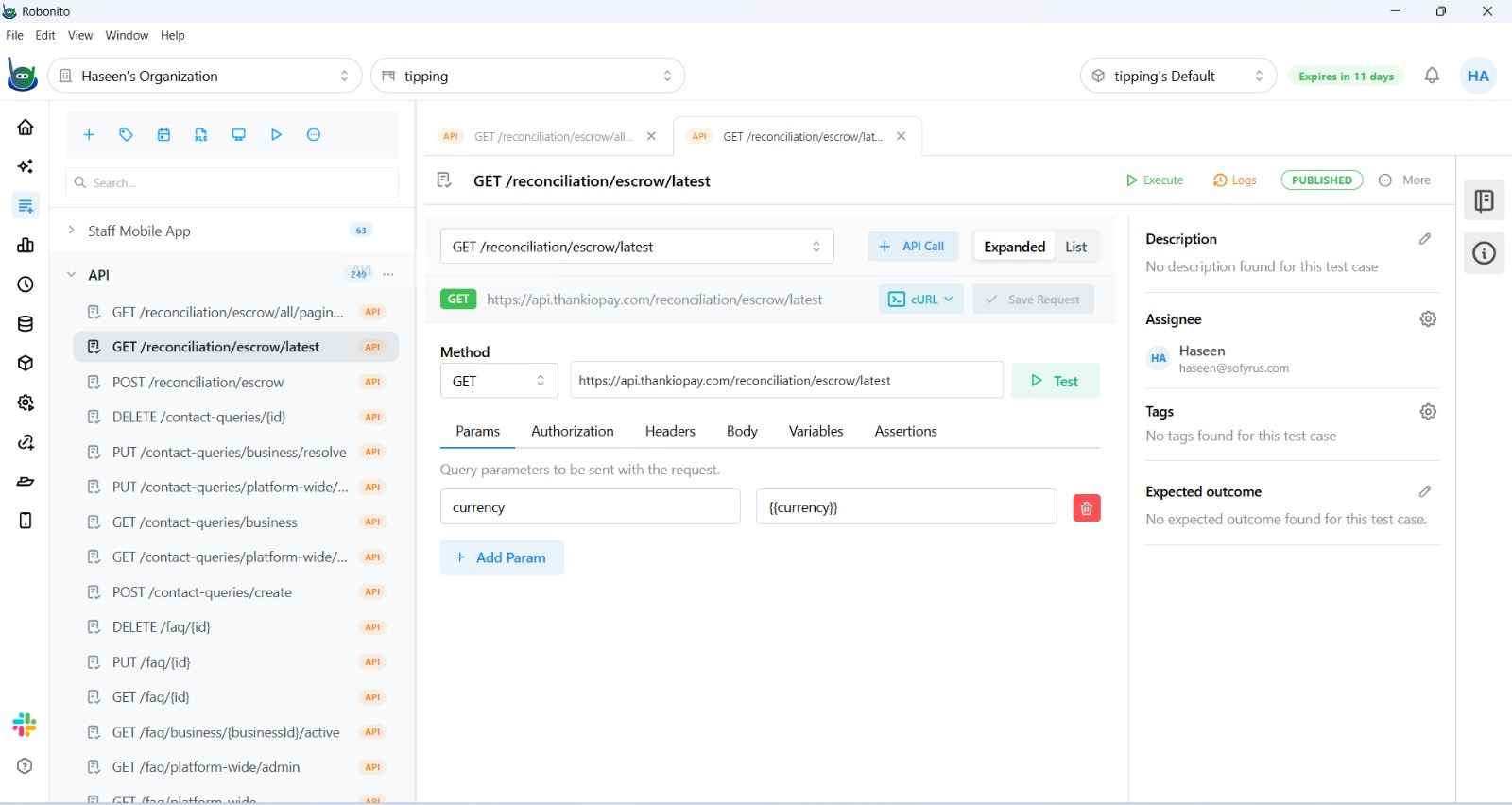
Chaining is built on top of Robonito's Variable Extraction system. In each API step, you define which values to extract from the response and what variable names to give them. Downstream steps reference those variables using {{variableName}} in any field — URL, headers, query params, or request body.
Step 1: POST /auth/login
  → Extract: $.accessToken → {{authToken}}
  → Extract: $.user.id    → {{userId}}

Step 2: GET /users/{{userId}}
  → Header: Authorization: Bearer {{authToken}}

Step 3: PATCH /users/{{userId}}
  → Header: Authorization: Bearer {{authToken}}
  → Body:   { "role": "admin" }
Setting Up a Chain
Step 1 — Create the API Test Case
Create a new API test case. Each API test case can contain multiple request steps chained together. See Creating an API Test Case for setup.
Step 2 — Configure the First Request
Set the HTTP method, URL, headers, authentication, and body for your first request (e.g., POST /auth/login). See Configure API Endpoint.
Step 3 — Extract Variables from the Response
- In the first request's step, go to the Variables tab.
- Click Extract Variable.
- Set:
- Variable Name — e.g.,
authToken - Source —
Response Body (JSON) - JSONPath — e.g.,
$.accessToken
- Variable Name — e.g.,
- Add as many extractions as needed.

Step 4 — Add the Next Request Step
Click + Add Step in the test case timeline to add another API request. This step will consume the extracted variable.
Step 5 — Inject Variables into the Next Request
In the second request, reference the extracted variable anywhere:
- URL:
https://api.myapp.com/users/{{userId}} - Header:
Authorization: Bearer {{authToken}} - Query Parameter:
?ownerId={{userId}} - Request Body:
{
  "targetUser": "{{userId}}",
  "action": "promote"
}
Robonito resolves {{authToken}} and {{userId}} at runtime using the values extracted in the previous step.
Variable Scope in Chains
Variables extracted in an API test case step are available to all subsequent steps in the same test case. If you have 5 chained requests, a variable extracted in step 1 is accessible in steps 2 through 5.
Variables are also promoted to the parent test's scope when the API test case is embedded as a Reuse Test step, enabling API chains to feed data to UI test steps as well.
A Real-World Example: Full CRUD Chain
The following chain validates a complete user lifecycle — create, read, update, delete:
Step 1: Authenticate
POST /auth/login
Body: { "email": "{{adminEmail}}", "password": "{{adminPassword}}" }
Extract: $.token → {{authToken}}
Step 2: Create a User
POST /users
Header: Authorization: Bearer {{authToken}}
Body: { "name": "Test User", "email": "{{$email}}" }
Extract: $.id → {{newUserId}}
Assert: Status Code = 201
Step 3: Fetch the Created User
GET /users/{{newUserId}}
Header: Authorization: Bearer {{authToken}}
Assert: $.name = "Test User"
Assert: Status Code = 200
Step 4: Update the User
PATCH /users/{{newUserId}}
Header: Authorization: Bearer {{authToken}}
Body: { "role": "admin" }
Assert: $.role = "admin"
Assert: Status Code = 200
Step 5: Delete the User
DELETE /users/{{newUserId}}
Header: Authorization: Bearer {{authToken}}
Assert: Status Code = 204
This five-step chain validates the complete API contract for user management — from authentication to cleanup — using a single test case.
Importing Existing Collections
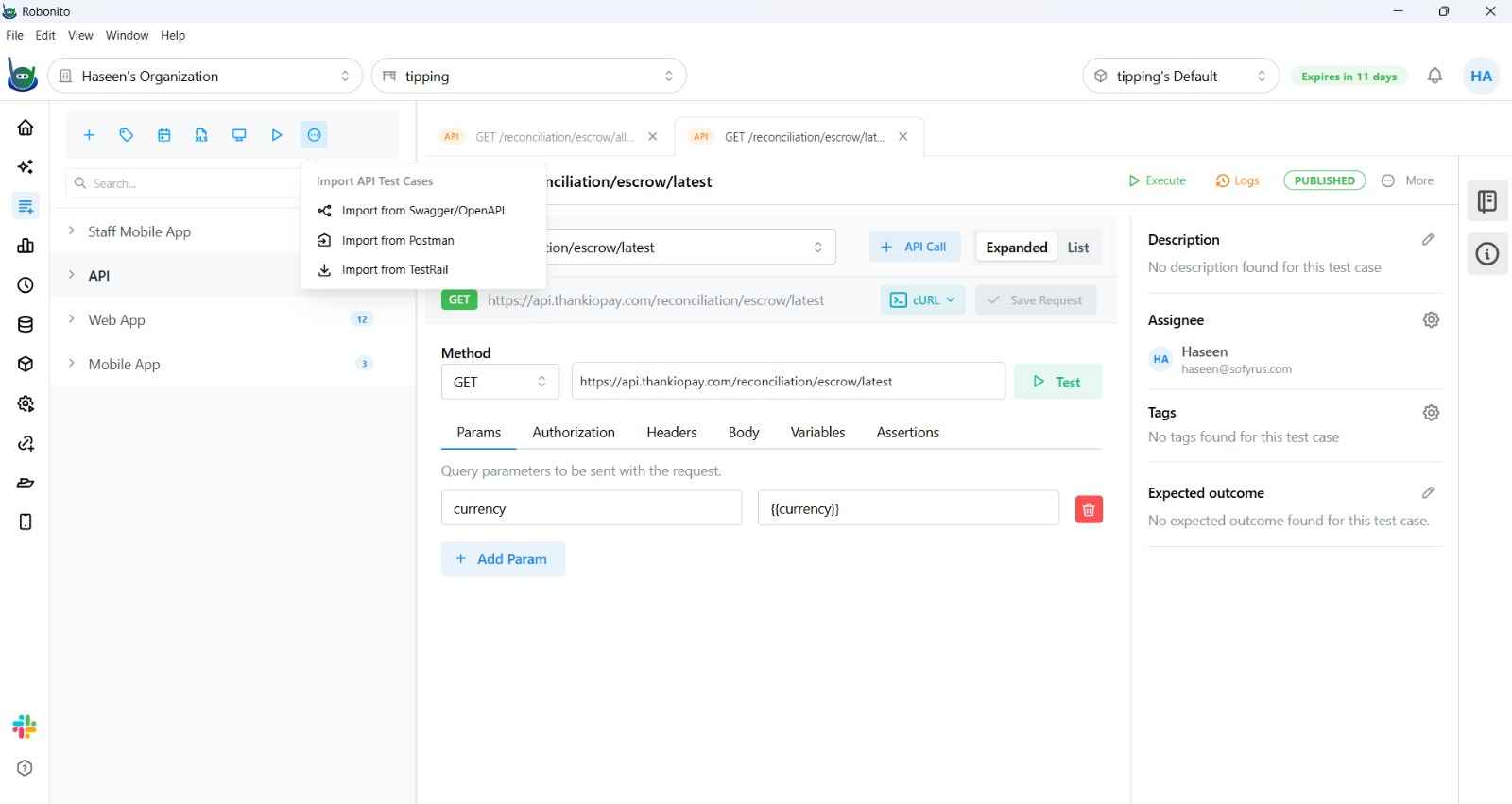
If you already have API requests documented in Postman or an OpenAPI/Swagger spec, Robonito can import them directly rather than requiring you to configure every request manually.
Import from Postman
- Export your Postman Collection as a Collection v2 JSON file.
- In the API Test Case editor, click Import → Postman Collection.
- Select the exported
.jsonfile. - Robonito converts each Postman request into a Robonito API step, preserving methods, URLs, headers, and body payloads.
Import from OpenAPI / Swagger
- In the API Test Case editor, click Import → Swagger / OpenAPI.
- Enter the URL of your OpenAPI spec (e.g.,
https://api.myapp.com/openapi.json) or upload the file. - Select the endpoints you want to import.
- Robonito generates the corresponding request steps.
Tips for Reliable Chains
- Assert after each step — don't only assert at the end. If step 2 fails silently (wrong status code), step 3 will likely fail for a confusing reason.
- Use specific JSONPath —
$.data.user.idis more reliable than$.idwhen APIs wrap responses in data envelopes. - Use Secret variables for credentials — put
{{adminPassword}}in a Secret environment variable, not hardcoded in the body. - Chain API tests with UI tests — use a Reuse Test step to run an API authentication chain before a web UI test, so the UI test starts with a valid session token.