Managing Test Suites
Test Suites are organizational containers used to logically group related test cases together (e.g., "Authentication Flow" or "Checkout Core").
1. Creating a New Suite
To isolate a new batch of tests:
-
New Suite: Click the
+ New Suitebutton located in the top-left corner of the Robonito sidebar.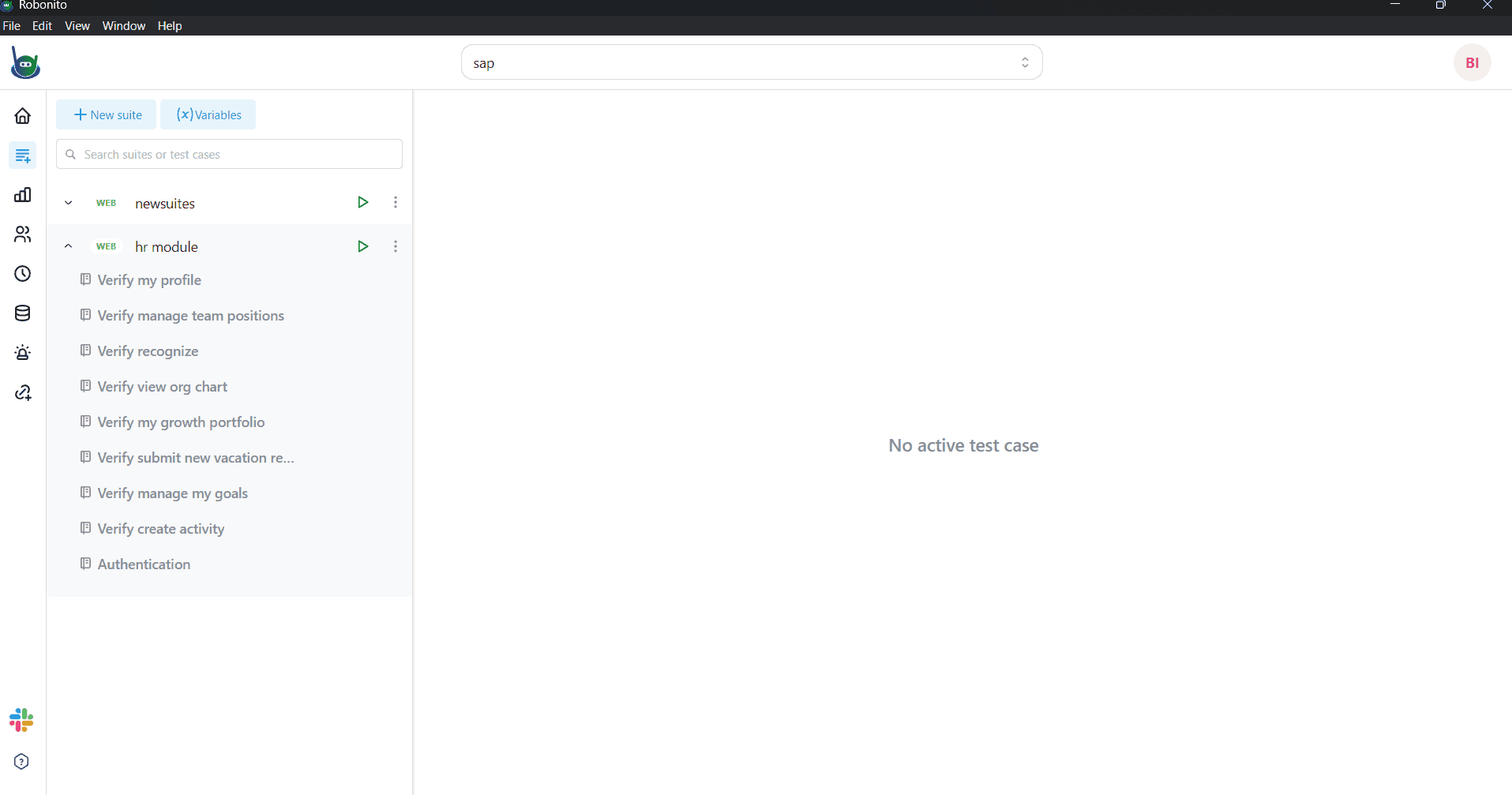
-
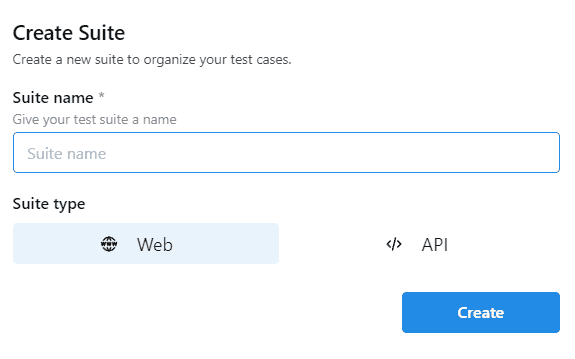
Name: Provide a descriptive identifier in the "Suite Name" field (e.g., "Checkout Cart").
-
Platform Type: Robonito explicitly isolates test architectures natively. You must pick the target execution environment for the suite:
- Web: For browser-based UI functionality.
- API: For executing backend endpoint tests.
- Mobile: For native iOS and Android application UI tests.
-
Save: Click Create to initialize the suite.
2. Managing Your Suites
Click the ellipsis (three dots) next to any suite name to open its context menu:
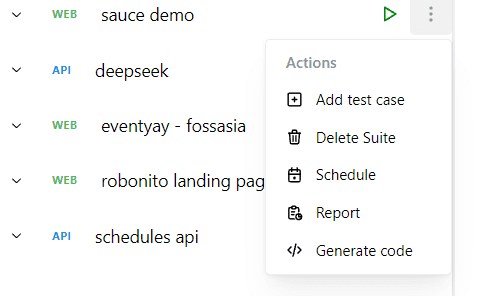
From this menu, you can selectively trigger the following lifecycle events:
- Add Test Case: Initialize a new blank test case natively mapped to the suite's underlying architecture type.
- Schedule: Queue the entire suite to execute automatically at defined recurring cron intervals.
- Report: View unified Execution Reports mapping test pass/fail ratios specifically for this suite cluster.
- Delete Suite: Permanently destroy the suite and all dynamically nested test cases.
3. Batch Suite Execution
By grouping tests into suites, you unlock the ability to trigger batch executions.
Rather than selecting individual test cases, you can click the Execute button at the Suite level to recursively run all internal tests sequentially:
- Local Execution: Utilize your host machine hardware to physically launch and execute the suite in real-time.
- Cloud Execution: Offload the suite to Robonito's scalable cloud clusters.
As the suite runs iteratively, Robonito naturally coalesces the independent completion boundaries of every test case into a single execution report.